
Acumen Edelman Trust Barometer 2026
Acumen Edelman Trust Barometer finds New Zealand’s trust shifts inward amid uncertainty
New Zealanders have traditionally seen ourselves as open, outward-looking and tolerant. But new research confirms that is shifting – and not in a direction that supports progress.
The 2026 Acumen Edelman Trust Barometer* shows a clear move away from shared understanding towards a more inward-looking mindset, where people are increasingly cautious about those who see the world differently.
Around three-quarters of New Zealanders (76%, on average) are now hesitant or unwilling to trust someone whose values, beliefs, approaches to problem-solving, or background differ from their own. People are increasingly sticking with what and who they know, retreating into familiar circles for information, relationships and reassurance.
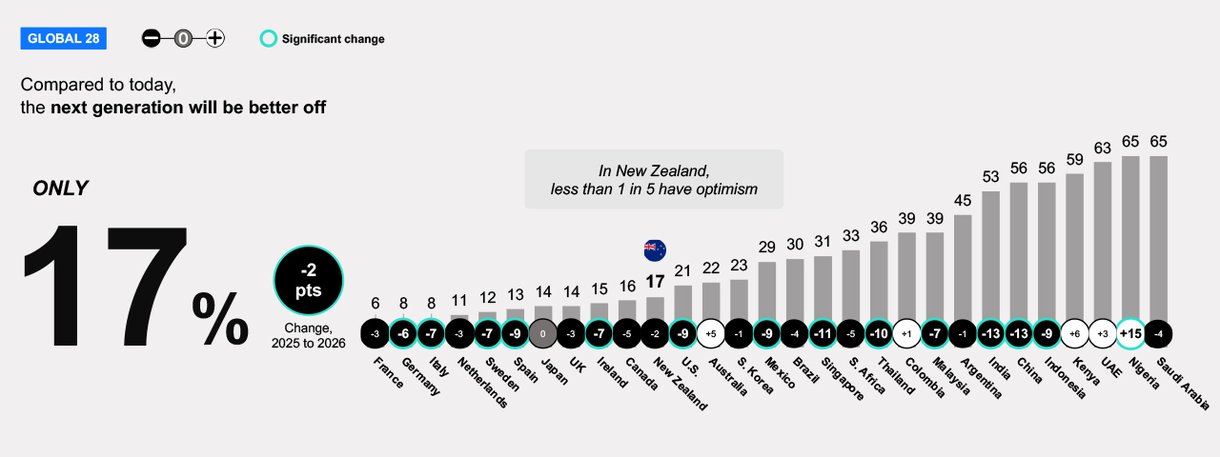
At the heart of this shift is a more uncertain environment. Economic pressure, the rapid pace of technological change, and the ongoing impact of misinformation are all contributing to a loss of confidence about the future. Fewer than one in five New Zealanders (17%) believe the next generation will be better off compared to today, and fears around job security and global instability are rising.
At the same time, the communities and markets we operate in are diverse. Navigating that environment requires an ability to connect across difference. Without it, it becomes harder for organisations and leaders to build alignment, earn trust, and operate effectively.
“We’ve traditionally prided ourselves on being open and tolerant,” says Keely. “What we’re seeing now is a clear shift away from ‘we’ to ‘me’ – towards caution and selectivity in who and what we trust. This inward turn has real consequences – not just socially, but economically,” said Adelle Keely, Chief Executive at Acumen.
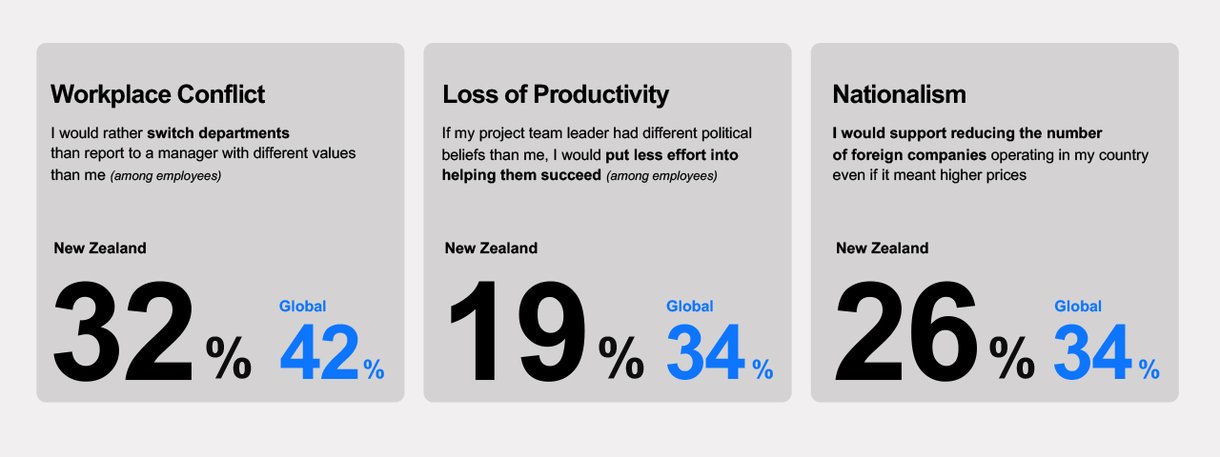
When people are less willing to engage with those who think differently, it becomes harder to collaborate, innovate and make progress. Nearly a third of New Zealand employees (32%) say they would rather switch teams than work for a manager with different values, and some (19%) admit they would put in less effort if they disagreed with their team leader’s views.
“If we lose the ability to work and collaborate across difference, we risk slowing productivity, limiting innovation, and making it harder to get ahead,” Keely said.
“At the same time, this is not about forcing agreement. In a complex world, perfect alignment isn’t realistic – nor is it necessary. What matters is maintaining an environment where it’s okay to disagree, where there is respect for different perspectives, and where we can all still get on with the job.”
While New Zealand is not experiencing the same level of division seen in some other countries, nearly seven in ten (68%) believe people here distrusting those with different views so much that they actively work against each other is a serious problem that needs solving.
This signals a growing challenge in maintaining shared understanding across an increasingly diverse society. The research highlights a clear opportunity – and responsibility – for institutions to rebuild trust in a more practical, grounded way.
Employers are uniquely placed to lead. They remain the most trusted institution in New Zealand (trusted by 77% of employees in New Zealand). The workplace is one of the few environments where people regularly interact with others who are different from them.
This creates a powerful opportunity to:
- Bring together people with different perspectives
- Build shared goals and a sense of common purpose
- Equip people to have constructive conversations, even when they disagree
More broadly, rebuilding trust will require a collective effort:
- Businesses can create environments that encourage connection across difference
- NGOs can help translate and bridge understanding between groups
- Government can set the tone through inclusive, unifying leadership
- Media can reduce division by prioritising accuracy and balance over amplification
“Trust isn’t built by surrounding ourselves with people who agree with us,” said Keely. “It’s built by engaging with difference – listening with respect, seeking to understand, and finding common ground where we can. If we want to unlock growth and progress, we need to rebuild that capability.”
Want to know more about Trust in Aotearoa?
Contact us to request your copy.